Machine Learning and Smart Control
■ Technology Introduction
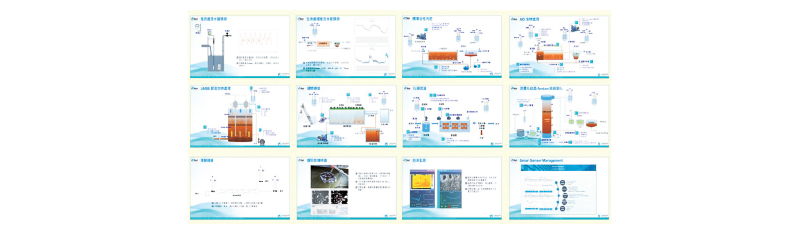
This process is a digital transformation of water treatment. Data on variable influent flow rates and water quality are collected via online sensors. Combined with operational parameters from the plant, these serve as the inputs for machine learning. Using AI model algorithm, the optimal set of operating parameters is generated and sent back to the equipment for real-time control. The precise and adaptive operation senable more stable effluent water quality, reduce energy and chemical consumption, and significantly lower manpower requirements.
■ Technology Feature
▶ Water quality prediction.
▶ Hybrid model of theoretic and data science model.
▶ Multi-operation parameter optimization search.
▶ Smart sensor management and data pretreatment.
▶ Edge intelligence.
▶ Soft sensing.
■ Application Area
▶ Prediction of influent and effluent.
▶ Anerobic biological treatment.
▶ Biological nutrients removal treatment.
▶ Chemical precipitation.
▶ Membrane filtration.
▶ Advanced oxidation processes.
■ Reference
▶ Science Park Wastewater Treatment Plants.
◆ Smart control of Hsinchu Science Park wastewater treatment plant biological nitrogen
removal and coagulation sedimentation.
◆ Tainan Science Park, Houli Science Park and Tongluo Science Park WWTP smart control.
▶ Precision chemical dosing for coagulation and sedimentation for Taiwan Water Corporation
water purification plants.
▶ Smart control of Zhudong Water Recycling Center.
▶ Smart control of a industrial wastewater recycling facility.
▶ Water quality prediction and early warning System for a petrochemical plant wastewater
treatment.
Application of Image Recognition Technology in Water Treatment
■ Technology Introduction
During the water treatment operations, certain process conditions rely on the human senses, such as color, appearance, and odor. Artificial intelligence-based image recognition technology can digitize image data, further perform calculations, and apply it to water treatment processes. Our team apply AI image recognition technology to the chemical sludge flocculation process and to monitor foam generation during water treatment.
■ Technology Feature
▶ Image feature digitization.
▶ AI image recognition.
▶ Extracting image features as input for machine learning.
■ Photos of Image analysis
■ Application Area
▶ petrochemical industry.
▶ Metal surface processing industry.
▶ Semiconductor industry.
▶ Biopharmaceutical manufacturers.
▶ Food industry.
▶ Others.
■ Patent
Foam detection system-Taiwan and Japan patent application in progress.
Technology Development Roadmap
■ Contact Us
Material and Chemical Research Laboratories
Dept. of Water Technology Research(Y000)
Wayne Lo
Tel:886-3-5732688
E-mail:waynelo.ubc@itri.org.tw